 Myopia surgery
 Myopia prevention and control
 Presbyopia
 Cataract
 Dry eye
 400-8600-525
 CN
 One City, Three Campuses

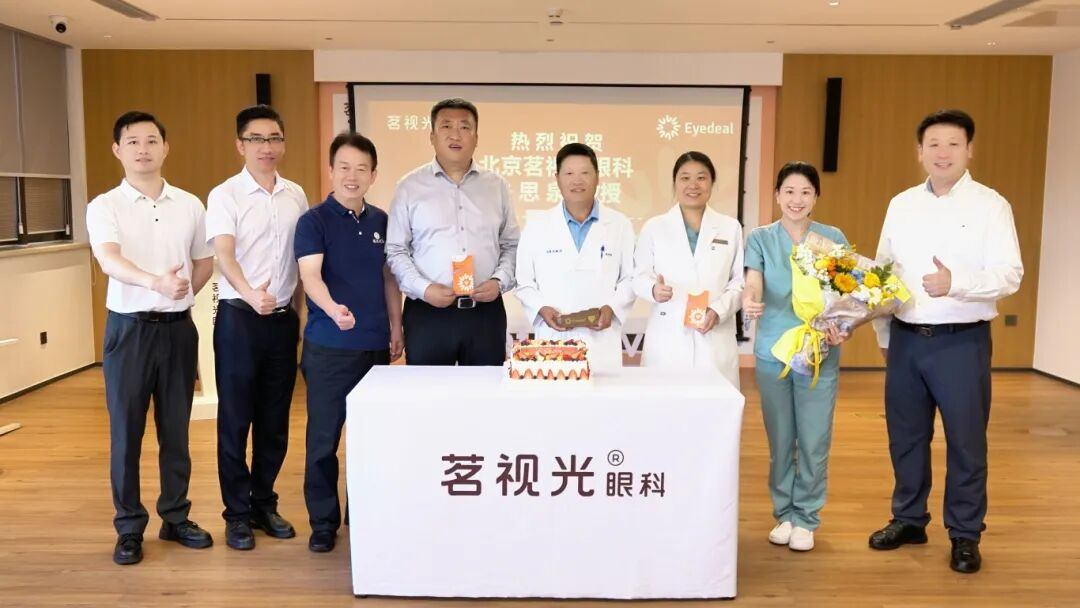
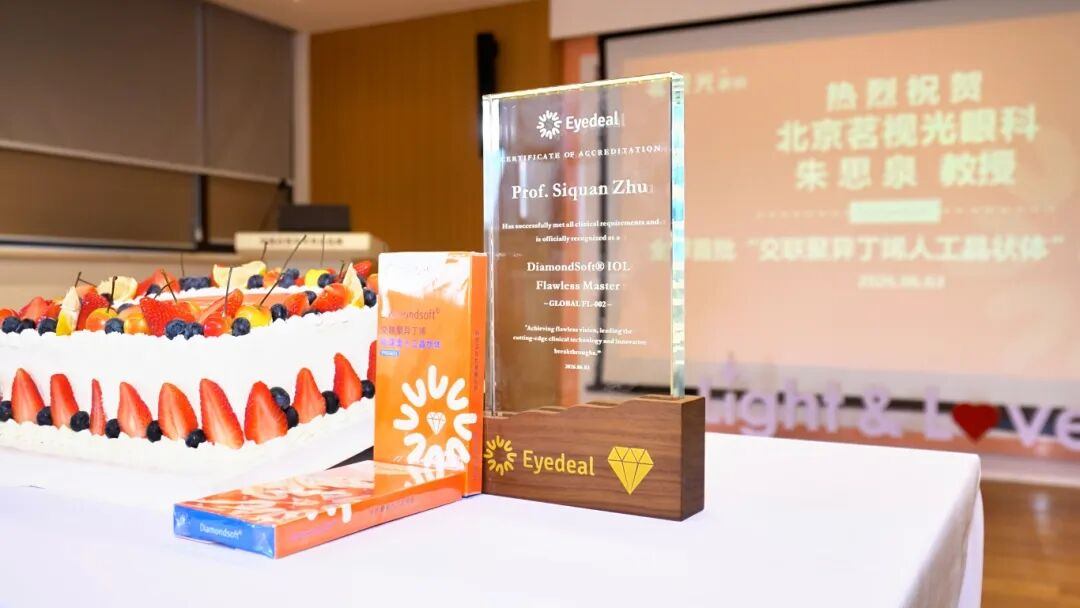
In June, the team of Professor Zhu Siquan at the Intraocular Lens Center of Beijing Ming Vision & Ophthalmology successfully completed the world's first batch of implantation surgeries using the DiamondSoft® (soft diamond) intraocular lens, a new material made of cross-linked polyisobutylene. It is understood that this is the first intraocular lens to adopt an entirely new material in nearly 30 years. The successful completion of these surgeries means that a new option in material has become available for cataract lens replacement surgery.
The patient, Mr. Yang (a pseudonym), is 55 years old. He underwent corneal laser surgery 20 years ago and had previously undergone cataract lens replacement surgery on his left eye. Now his right eye has also developed a cataract, and for this surgery he hoped that his right eye could achieve clearer and better vision.
Mr. Yang came to the Intraocular Lens Center of Beijing Ming Vision & Ophthalmology and consulted Professor Zhu Siquan. After detailed examinations and communication, Professor Zhu recommended to him the DiamondSoft® (soft diamond) intraocular lens made of the new cross-linked polyisobutylene material.
"Professor Zhu explained to me that this lens material is very soft, yet its structure is very stable, and its optical zone is larger than that of previous lenses, reaching 6.5 mm, which is much friendlier for people like me who have had corneal laser surgery," Mr. Yang recalled.
On the day of the surgery, with the precise coordination of femtosecond laser assistance by the Ming Vision team and the 3D navigation microscope, Professor Zhu Siquan successfully completed the lens replacement for Mr. Yang. Professor Zhu noted that for people who have had corneal laser surgery and later develop cataracts as they grow older, the choice of intraocular lens for lens replacement surgery needs to be made in a scientific manner by taking multiple examination results into account.
"Everything looks very clear and especially bright!" Mr. Yang was very satisfied with the postoperative outcome. "My vision is good both for distance and for near, and the visual quality of this new-material lens is even better than that of my left eye, which was operated on in the past."
Ming Vision & Ophthalmology Excels in
Cataract Surgery Design After Refractive Surgery
Ming Vision & Ophthalmology specializes in refractive surgery and has accumulated rich experience and data in the design of cataract surgery after refractive surgery. Because the patient's cornea has already been corrected by laser surgery, special circumstances exist such as changes in corneal curvature and alterations in aberrations, so the choice of intraocular lens requires multi-factor evaluation and scientific prediction. For such patients, Ming Vision & Ophthalmology designs personalized plans based on the patient's previous refractive surgery records, combined with multiple calculation formulas, physicians' experience and AI big data cross-validation, matched with intraocular lenses of different optical designs, so as to guarantee postoperative visual quality to the greatest extent and meet the patient's need for clear vision.
The smooth completion by Professor Zhu Siquan of the world's first batch of implantations of intraocular lenses made of soft diamond material this time also relied on the diagnostic and treatment experience that the center has accumulated over many years in the field of cataracts after refractive surgery, which is what guarantees the precision of the surgery and makes it possible to obtain the expected visual quality.
According to medical industry norms, medical institutions generally keep patients' physical medical records relating to myopia surgery for 15 years. In 2025, Beijing Ming Vision & Ophthalmology mobilized the resources of the entire hospital to electronically archive the complete set of examination records of clients from the hospital's establishment in 2011 through 2025, while the physical records continue to be preserved for 15 years in accordance with medical industry norms. The long-term preservation of electronically archived records is of great significance for parameter design when clients undergo cataract, presbyopia and other surgeries decades later, and this is an important guarantee that Ming Vision & Ophthalmology provides for full life-cycle eye health services for its clients.
Innovation in Intraocular Lens Materials in the Ophthalmic Industry Over the Past 30 Years
What Does It Mean? Who Is It Suitable For?
Over the past nearly 30 years, intraocular lenses have continuously iterated in optical design — from monofocal to bifocal, trifocal, continuous range of vision and extended depth of focus — yet the base material used has always been mainly acrylate, without any fundamental change.
According to the introduction, the cross-linked polyisobutylene material used in the DiamondSoft® lens has a molecular structure containing only carbon and hydrogen, with no easily hydrolyzable groups; it neither degrades nor becomes brittle, which reduces at the source of the material the risk of calcification and glistening that may appear in traditional lenses over the long term. At the same time, the lens features a high refractive index (1.52), a high Abbe number (50) and an ultra-large 6.5 mm optic, and can be implanted through a small incision of only 1.8–2.2 mm, balancing the minimally invasive nature of the surgery with postoperative visual quality.
Apart from being suitable for patients with a history of refractive surgery, the ultra-large 6.5 mm optic of this lens is also especially suitable for the following groups of patients: first, patients with high myopia accompanied by fundus atrophy, for whom the enlarged optical zone allows more light to enter the eye and improves visual quality; second, patients with diabetic retinopathy, for whom it can help overcome the visual problems caused by damage such as fundus hemorrhage and microaneurysms; third, patients with ischemic optic neuropathy, for whom a wider visual field range can provide more visual information; fourth, patients with glaucomatous visual field defects, for whom it makes better use of the remaining normal visual field; and fifth, patients with large pupils, for whom it can effectively reduce night glare interference, significantly improving night vision as well as the experience of working and driving at night.

Since establishing its Intraocular Lens Center in 2023, Ming Vision & Ophthalmology has focused on refractive presbyopia and cataracts, especially the diagnosis and treatment of cataracts after refractive surgery, and has consistently kept up with the development and application of new types of intraocular lenses worldwide. From being among the first in China to perform femtosecond laser-assisted cataract surgery, to taking the lead in introducing monofocal extended depth of focus, trifocal, continuous range of vision and toric lenses, then to being among the first batch in China to adopt the new generation of full range of vision lenses, and now to completing the implantation of the first new-material lens in nearly 30 years, the Intraocular Lens Center of Beijing Ming Vision & Ophthalmology has always taken professionalism as its core and used technology to fulfill its clients' dreams of a better life.
In the 15 years since the founding of Ming Vision & Ophthalmology, it has grown just as strong as the standardized corneal laser surgery system jointly led by Professor Zhou Yuehua and Professor Li Ying. The intraocular lens surgery center led by Professor Zhu Siquan has established a systematic and standardized refractive cataract surgery system. Based on each patient's age, occupation, eye usage habits and personalized needs, and through the continuous accumulation of diagnostic and treatment data and the optimization of surgical design plans, it helps patients obtain more ideal long-term visual quality and provides full life-cycle eye health solutions.
 Online Booking

 Tel
 WeChat

 Address

 Consult